
Leveraging Hyperglass and NSX-T!
For this example deployment, I’ll be using my NSX-T Lab as the fabric, VyOS for the Overloaded Router role, and trying out hyperglass:
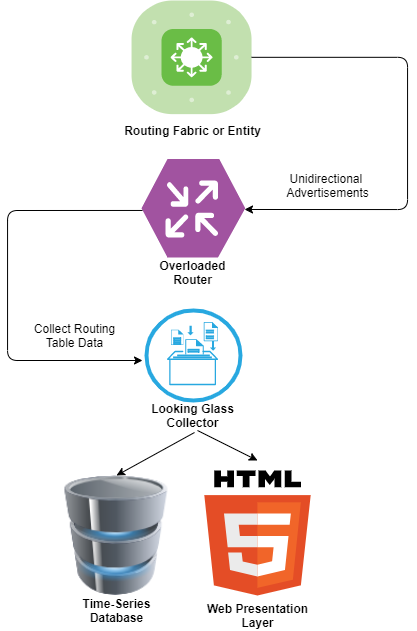
Installation (VyOS)
I already have a base image for VyOS with its management VRF set up - and updating the base image prior to deployment is a breeze due to the vSphere 7 VM Template Check Out Feature.
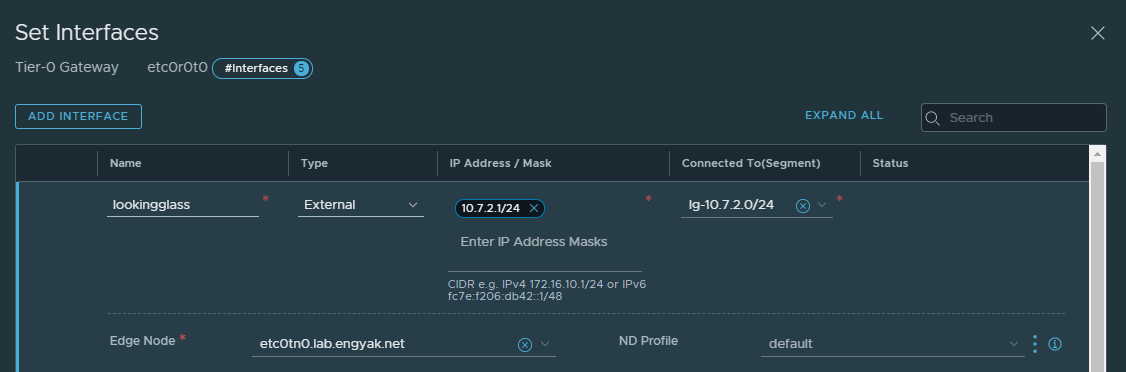
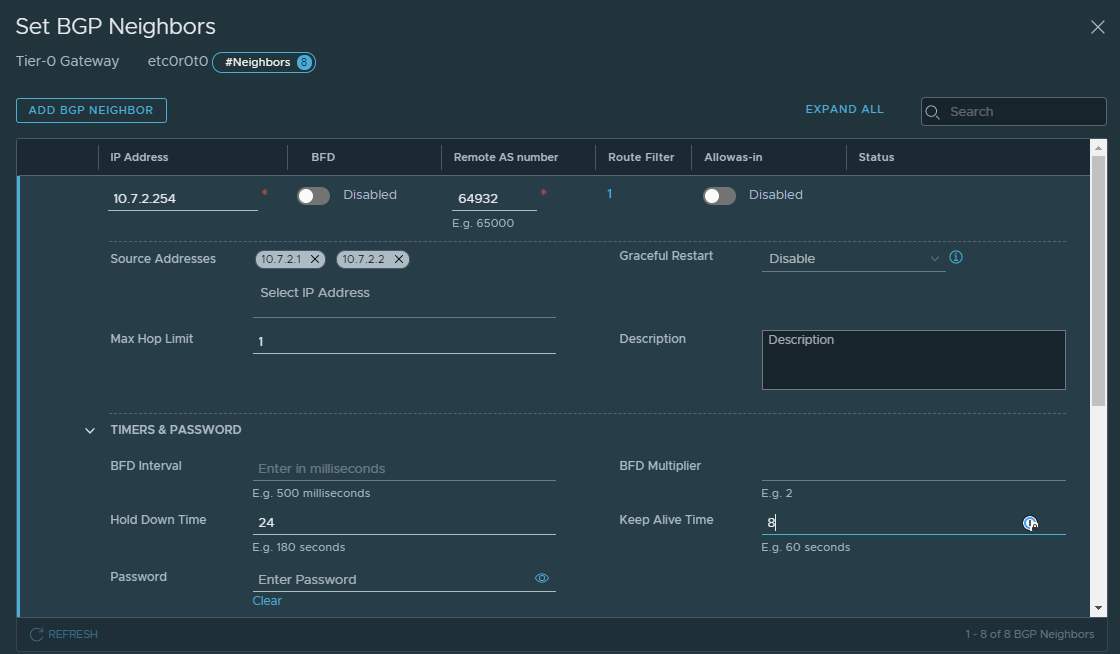
In this case, I’ll deploy to an NSX-T External Port and peer up, with fully implemented ingress filtering:
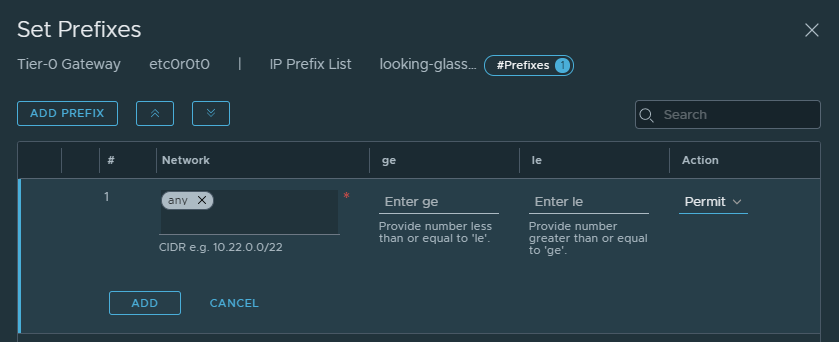
Export Filters - Permit all prefixes:
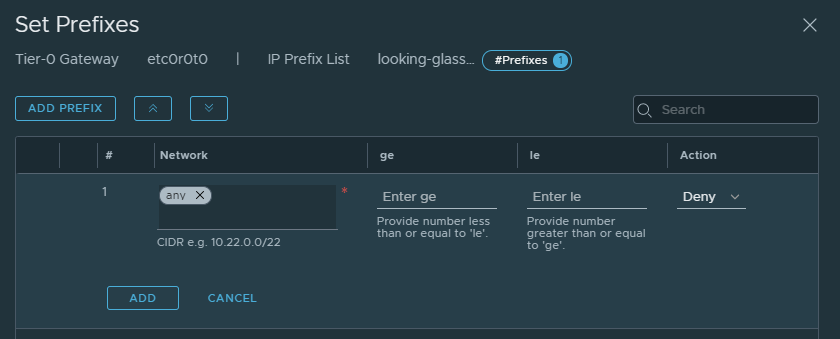
Import Filters - don’t trust any prefixes from this router:
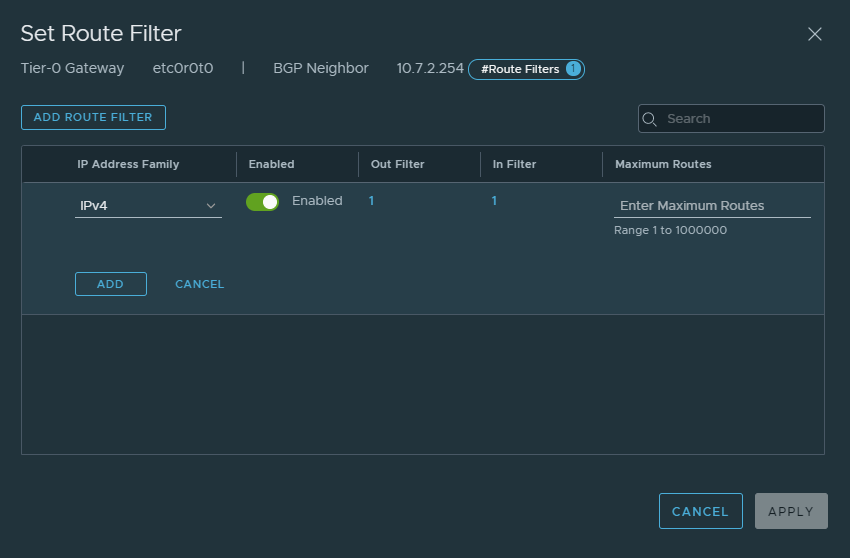
Set in the correct directions:
Configure the BGP Neighbors:
From here, we build the VNF, by adding the following configuration:
protocols {
    bgp 64932 {
        address-family {
            ipv4-unicast {
                maximum-paths {
                    ebgp 4
                }
            }
            ipv6-unicast {
                maximum-paths {
                    ebgp 4
                }
            }
        }
        neighbor 10.7.2.1 {
            remote-as 64902
        }
        neighbor 10.7.2.2 {
            remote-as 64902
        }
        neighbor x:x:x:dea::1 {
            address-family {
                ipv6-unicast {
                }
            }
            remote-as 64902
        }
        neighbor x:x:x:dea::2 {
            address-family {
                ipv6-unicast {
                }
            }
            remote-as 64902
        }
        timers {
            holdtime 12
            keepalive 4
        }
    }
}
Then, let’s verify that BGP is working:
vyos@vyos-lg-01:~$ show ip bgp summary

IPv4 Unicast Summary:
BGP router identifier 10.7.2.254, local AS number 64932 vrf-id 0
BGP table version 156
RIB entries 75, using 14 KiB of memory
Peers 4, using 85 KiB of memory

Neighbor             V         AS   MsgRcvd   MsgSent   TblVer  InQ OutQ  Up/Down State/PfxRcd   PfxSnt
10.7.2.1             4      64902       278       272        0    0    0 00:11:31           40       42
10.7.2.2             4      64902        16        13        0    0    0 00:00:16           39       42
x:x:x:dea::1 		 4      64902       234       264        0    0    0 00:11:43 NoNeg
x:x:x:dea::2 		 4      64902       283       368        0    0    0 00:11:43 NoNeg

Total number of neighbors 4
The VNF is configured! Now, we’ll follow the application maintainer’s instructions for installation: https://hyperglass.io/docs/getting-started
The documentation for install is pretty good - but some customization is still required. I built the following configuration files out - hyperglass leverages YAML as a configuration file format, examples are here. I did make some changes:
- Some combination of VyOS 1.4, MP-BGP, and/or VRF-lite changed the syntax for the BGP views around. Setting a commands file fixes this.
- VyOS driver is appending a host mask (/32, /128) on routes with no prefix specified.
- NB: I reached out to the maintainer (Matt Love) and he informed me that this was configurable per-VRF using the force-cidr option.
This particular tool has been extremely useful to me, as NSX-T still lacks comprehensive BGP visibility without CLI access - and even if it didn’t, this will provide consumers an easy way to validate that prefixes have propagated, and where.